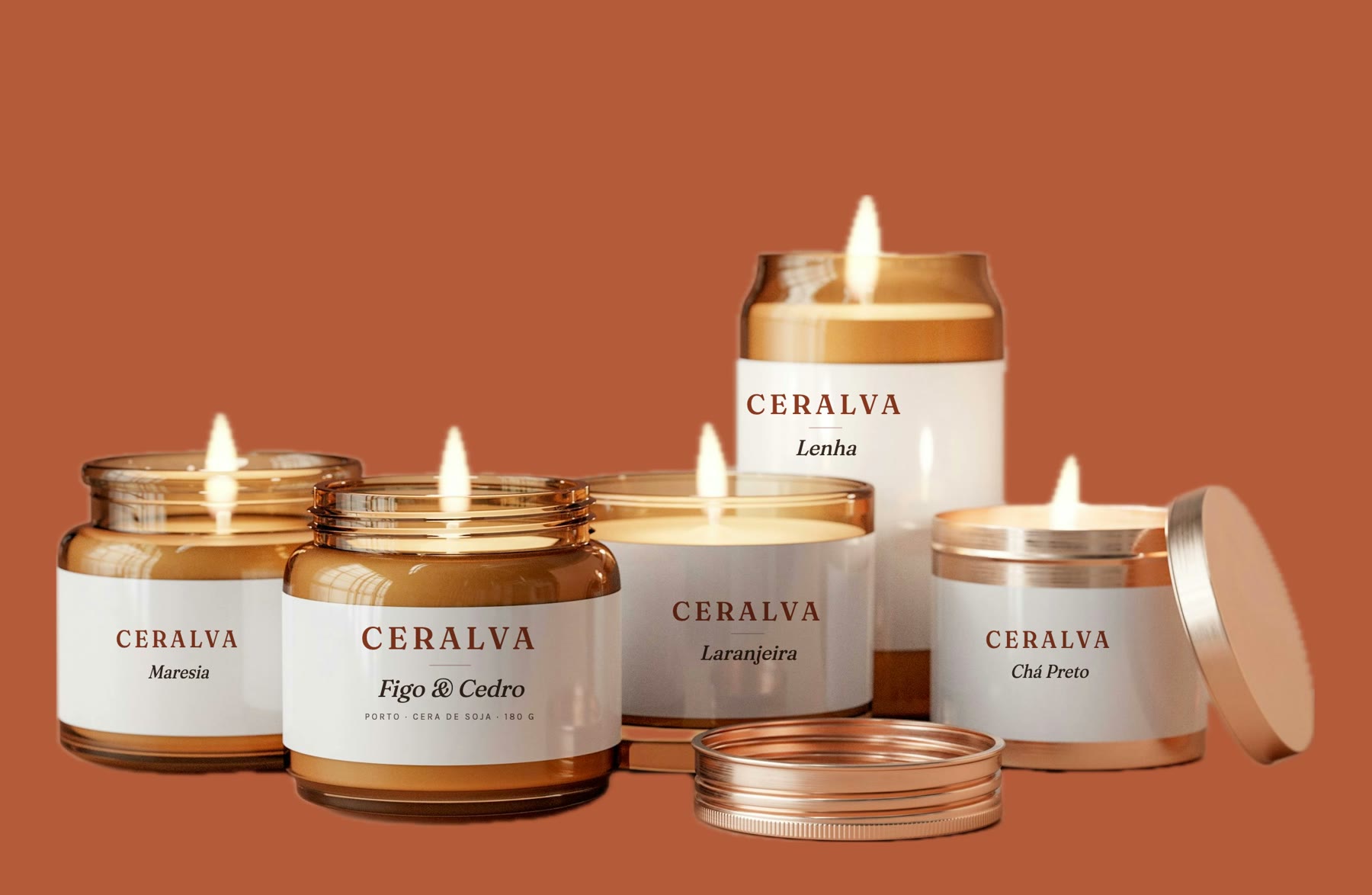
When you sell physical products, your brand lives in more places than a software company's: the online store, the packaging, the label, the shipping box, the market stall, the photos customers post. Each one gets made by someone different, often a printer or a photographer you've never met.
Ecommerce brand guidelines keep all of that consistent. Here's what to include, using Ceralva, a Porto soy candle maker and one of our example brands.
The product is the brand
For a product brand, the most important page in the guidelines is usually the product itself. Ceralva's book has a Products section with the candles photographed on cream, on terracotta and in a real room. It shows:
- How products are photographed: background colors, light, angle.
- How the label looks: the wordmark, the scent name in italics, the small line with city, wax and weight.
- How products appear together: the full collection as a group.
If you sell more than a handful of products, add rules for product photos: one background color for catalog shots, lifestyle photos in natural light, no heavy filters. Consistent photos do more for an online store than almost any other brand rule.
Colors that work on screen and in print
Product brands print a lot: labels, boxes, tissue paper, cards, stickers. So the color section needs codes for both:
| Color | Role | HEX | CMYK |
|---|---|---|---|
| Terracotta | Primary | #A8482A | C0 M57 Y75 K34 |
| Sage | Accent | #7C8466 | C6 M0 Y23 K48 |
| Cream | Background | #F3EBDD | C0 M3 Y9 K5 |
CMYK values converted from screen colors are a starting point. Ask your printer for a proof before a big run, because paper and ink change how a color looks. Many product brands also choose Pantone spot colors for labels and boxes so the color stays exact. We explain the differences in HEX vs RGB vs CMYK.
Packaging and labels
Show the label as it really looks, and set the rules a printer or packaging designer needs:
- Logo placement and minimum size on small labels.
- Which fonts go where: Ceralva uses Fraunces for the wordmark and scent names, Karla for small details.
- Required information: weight, ingredients, care instructions, in a consistent order.
The online store
Your store theme needs the same decisions as any website: button colors, fonts, how product cards look. Ceralva's guidelines show the primary button as terracotta with cream text and sharp corners, which matches its small rectangular labels.
Show screenshots of the store on desktop and phone, because most product browsing happens on phones.
Voice for product pages
Product descriptions are where small brands sound most generic. Guidelines help. Ceralva's voice traits come from its own site:
Unhurried. "No rush, no shortcuts. Just good wax, good scent and a calmer evening."
Plainly precise. "Small batches of 60, numbered on the base."
Notice what's missing: no "luxurious", no "elevate your space". Precise, plain details sell handmade products better than adjectives.
Social and marketplace pieces
Product brands post constantly and often sell on marketplaces too. Include ready-made files: social covers, a profile picture that works as a small circle, a business card for markets and fairs, and an email signature for wholesale conversations.
An ecommerce brand guidelines checklist
- Logo, including a version for small labels
- Colors with HEX, RGB and CMYK, plus Pantone if you print a lot
- Fonts for the store, labels and packaging
- Product photo rules and examples
- Label and packaging layout
- Store screenshots on desktop and phone
- Voice traits with real product-page lines
- Social covers, profile picture, business card, email signature
Frequently asked questions
What should ecommerce brand guidelines include?
Everything a standard brand book has, logo, colors, fonts and voice, plus product photography rules, packaging and label layouts, print color codes and screenshots of the online store.
Why do product brands need CMYK colors?
Because labels, boxes and printed cards use ink, not light. CMYK codes, or Pantone for exact matches, tell printers how to reproduce your colors on paper.
How do I keep product photos consistent?
Pick one background and lighting setup for catalog shots, write it down in your guidelines with examples, and use the same setup every time you add a product.
See your own brand as a book.
Paste your website. The scan is free and takes about a minute.